
Wednesday, 12 September 2007

Ego and the Empire of Puddles


If anyone was under the illusion that life is invariably better under the umbrella of "independent COGs" rather than "orgs", the name Port Austin should serve as a massive wake-up call. After trawling through some of the comments about the previous entry, I made a solemn promise never to open up that can of worms to public comment again.

It's all reminiscent of Dr. Seuss' tale of Yertle the Turtle. It may be a small pond, but there's always an ego ready to fill it. One Yertle per pond: all other pretenders will need to find their own puddles to exercise sovereignty over. The pre-Yertle generation called the phenomena "Lord Muck of Muck Manor" (and several less salubrious variations which are inappropriate to share here.)

The passions of the parish pump are almost always more intense than those of national bodies. Just because a church calls itself independent is no guarantee of sweetness and light. Hurt feelings, hurled accusations: so much more intense when there's a personal history behind it.

Yet there are good independent congregations. I'm willing to bet that, in every case, those churches operate apart from a single resident guru. Successful churches recognize the need to listen, to consult, to involve, to find consensus and to compromise around a shared center of belief and commitment.

Compromise isn't a bad word, it's a life skill. You want to watch the big game, I want to catch the news. The solution doesn't need to involve partitioning the house or racing to be the first to grab the all-powerful remote. That's Yertle stuff.

If it's an independent church, ask how do they really run things. Is one person seen as the undisputed chief honcho (regardless of whether there's a paper board)? Does one person write all the literature, preside over all the important decisions, claim a higher level of enlightenment than the sheeple? Are members - the people who attend services and provide financial support - able to reach important decisions by meeting and discussing the issues without a Yertle pulling rank?

If it's a national body, the same principles apply. Who puts the leader(s) in charge? (And no, it sure isn't God!) What are the checks and balances? Is it effectively a one man band? If there's an elected structure, who gets to do the electing? The Church of God (Seventh Day) is a good example of how things can work. Is everybody happy? No, but everybody gets a chance to be heard and be taken seriously. Those who find that objectionable are probably budding Yertles, and like Herbert Armstrong, are better off fouling another puddle.

I'm sure there are some good people involved in the various Port Austin factions. But can you imagine trying to live a compassionate, Christian life while you're dealing with that kind of baggage? Even PCG might be preferable: there may be just as much toxin in their pond, but it's big enough to at least dilute it down a bit.

Yertles both great and small abound in COG history, and they all seem to collect tithes. But the real hero of that story is the "plain little turtle whose name was just Mack," the long-suffering little guy at the bottom of the heap who finally wises up and walks away.

Saturday, 8 September 2007

Matchmaker, matchmaker...

Norman Edwards is one of the more interesting characters to be found on the fringes of the Church of God. These days Norm appears to be keeping company with the Church of God (Seventh Day), while promoting his own Port Austin Bible Campus. The history of this latter institution reads a little like a soap opera all in itself, with a bitter parting of the ways between Norm and others involved in PABC's set-up. Among those on the other side of the fence, Homer Kizer and his Port Austin Bible Center (PABC2?)

Never mind, Norm has relaunched his once quite influential publication Servants' News, and you can download a PDF copy here. There's a lot that's noteworthy, but the following comments caught my eye.

Many of the young people there want to follow in the footsteps of their parents. They want to obey God and keep the Sabbath. They love to come there [the COG7 convention] and be among friends. But seven days is not long enough to make life-long close friends. It certainly is not long enough to decide whether or not one wants to consider marriage.

With small churches spread throughout the country, how do young people keep their relationship with God, prepare for a job, get a job and find someone of like belief to marry? One solution with which I have had personal experience: Caring Christians in areas where there are many young believers find a place to live and a suitable job for a young person from a sparse area. This allows the young person to remain in a Christian environment and get to know many other young people. I think this is a wonderful idea and I encourage other Christians to do this as they are able.

But most young people do not have this option available to them. That is why we hope to add PABC to their list of options.


Yes, Norm is concerned about the courting prospects of the young folk! How very old fashioned of him. If I'm not mistaken, Norm has expressed his desire for the "yoof" to go forth and multiply in intra-Sabbatarian style on other occasions. COG in-breeding? Certainly sends a shudder down my spine...

My advice to any young people out there is run like the wind! Whatever else may happen, never let yourself fall under the influence of anyone who seeks to limit your legitimate life-options and shrink your horizons. Beware those who crave control over others - regardless of pretext or "good intentions." The reason the Churches of God are full of gray heads, and failing to get traction with the youth demographic, is simple: they've got nothing to offer. Even if Norm manages to attract a few poor souls to shelter under PABC's wings, a quick perusal of this latest issue of Servants' News will quickly demonstrate whether what's on offer is out of touch and intellectually dubious.

Thursday, 6 September 2007

Holy Trinities, Batman!


I am grumbling my way through an essay on the Trinity as part of a university paper called "Doing Theology." I say "grumbling" because the paper is a compulsory one in the BTheol program, and because - despite long disassociation from Armstrongism - I'm a thorough-going skeptic over full-blown trinitarianism.

Later I want to expand on this subject, but for the moment I'd like to share some of the surprises that have cropped up in my reading.

* Catholic theologians cheerfully concede that there is no explicit doctrine of the Trinity in either Old or New Testaments. I've dug through Richard McBrien's excellent Catholicism before making this statement.

[W]e cannot read back into the New Testament, much less into the Old Testament, the trinitarian theology and doctrine which slowly and often unevenly developed over the course of some fifteen centuries.
(283)

* Evangelical theologians cheerfully concede that there is no explicit doctrine of the Trinity in either Old or New Testaments. I call British Anglican evangelical poster-boy Alister McGrath (Christian Theology, 2007 edition) to the witness box to demonstrate the veracity of that statement.

[N]either the developed trinitarian vocabulary or the specific concepts developed by Christian theologians to express the Christian vision of God are explicitly stated in the New Testament.
(249)

* The first person to use the term Trinity was the Montanist convert Tertullian. Tertullian abandoned Catholic Christianity to adopt the beliefs of a Holy Spirit obsessed sect. Remarkably then, the first "trinitarian" to self-identify under that label was a heretic.

Tertullian's Montanism helped him to insights by which the church eventually transcended this formula and developed a more consistent doctrine of the Trinity.
(Jaroslav Pelikan, The Emergence of the Catholic Tradition (100-600), 105.)


* Popular conservative theologian Larry Hurtado consistently describes the position of the early church as "binatarian."

The arguments used by orthodox theologians are sometimes creative, occasionally profound, and invariably subjective. Catholics have the easiest path through because they can fall back on the authority of tradition, something most of us feel more jaundiced about. But why let the facts get in the way? My favorite quote comes from Robert Jenson who, despite being Lutheran is a devotee of Reformed dogmatician Karl Barth.

Genesis' teaching about creation can only be accounted for by a full-blown doctrine of the Trinity.
(Jenson, "Creation as a Triune Act," Word & World 2/1 (1982), 39)

Yeah right: try convincing a rabbi. This is supercessionism gone crazy.

In any case, the subject, and the sheer bloody-mindedness of the dogmatic bias from certain mainline sectarian hacks, has set me thinking. Of course, finding problems with the Trinity doesn't mean that COG7-style binatarianism is thereby a better option, or Ken Westby-style "One God" unitarianism, and I'd want to make that go double for the near polytheism of the Armstrong/Mormon "God Family" teaching. Making sense of the God question in 2007 calls for something more radical and "out of the box" than squabbling over proof-texts and obscure philosophical mumbo-jumbo.

More on this at a later time.

Monday, 3 September 2007

Painful Truth passes first decade online

Ten years of The Painful Truth. Quite an accomplishment. Here's the announcement over at www.hwarmstrong.com
That's right, folks -- the Painful Truth has been on the web for ten years! For a full decade now hundreds, perhaps thousands, have visited these pages seeking information about Herbert Armstrong's Worldwide Church of God. Scores have contributed articles and emails, and hundreds have written to thank us for providing the information.
It hasn't all been roses. We've been thrown off the web twice, been threatened with lawsuits and even death, but as the Bible says..."The [painful] truth shall set you free"!
To celebrate this small anniversary, a few loyal readers have contributed articles for your enjoyment. More articles are anticipated (and you are free to submit your own). To begin reading, follow this link.
Among the contributors are M.A.M., who'll be known to those who frequented the pre-blog AW, the Most Rev. KScribe, the indomitable Douglas Becker and some dude with a name very similar to mine with the exception of an errant vowel.

The PT began through the vision of Ed Mentell Sr., and after a brief period under Mike Minton passed into the stewardship of John B. It's been attached to a variety of URLs over the years, so if you lost track, maybe it'd be wise to bookmark it. I can think of few other websites of this kind that have lasted the distance. All the best John.

Sunday, 2 September 2007

Wie habe ich dein Gesetze so lieb!


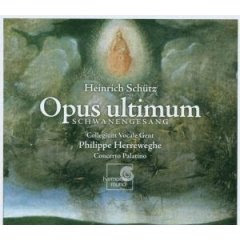
That's "O how love I thy law!" in German, specifically Heinrich Schutz's Opus ultimum, the Schwanengesang, a rendition of the tediously long Psalm 119. Performance of Schwanengesang takes more than 70 minutes, faithfully following Luther's translation, and the version I have is split between two CDs. Surprisingly, it's a joy to listen to.

Schutz was born in 1585, and this is his last major composition. It's light years removed from Dwight Armstrong's various attempts to harness the text of Psalm 119. The elder Armstrong brother took at least four bites at the task, and you can find them on pages 90 through 93 of the old purple hymnal. The music of the 1600s was something else again, difficult to describe, but, once you adjust to the style, strangely beautiful. The irony is that this particular work was only recovered in its entirety in 1970, and then performed in 1981. That may in fact have also been its premiere, for Schutz's patron, Georg II, had converted from Protestantism to Catholicism, and his musical tastes then took a decidedly Italian turn.

Psalm 119, which is a paean of praise to the Torah, seems an unlikely project for a German composer living in the shadow of the Reformation, and Luther's Old Testament an unlikely text, but stranger things have happened.

I can only say that even the least promising of the biblical texts can be transformed into something remarkable at the hands of a great artist. Whether you'll find the polyphonic pleasures of the seventeenth century to your taste (you'll listen in vain for a tune to hum!) may be judged by listening to the samples available on Amazon.

Sorry, no comments on this post. Back to normal next time ;-)

Friday, 31 August 2007

Genesis Genetics

Bob Thiel breathlessly announces: "AW Questions Historical Validity of Genesis" following the previous post.

The truth is that I usually give Bob a harder time than he gives me, so I'm not particularly worried - even if he infers (yet again) that I'm an atheist. "Sticks and stones..."

But I'm fascinated to know what Bob, committed as he is to the historical accuracy of Genesis, makes of the genetic modification technique practiced by Jacob in Genesis 30. Jacob has been repeatedly stiffed by Laban, the uncle from hell. He works seven years for the right to marry Rachel, but Laban sneaks in her sister Leah under cover of bridal burka. Next morning, after consummation, Jacob finally thinks to lift the veil and discovers the awful truth. Another seven years are required among the sheep before he can pay Laban off for his dearly intended.

Time passes. Jacob strikes a deal with his father-in-law. He will return home with his wives and children, and all the striped, spotted and speckled livestock from Laban's flocks will be his. Again, Laban tries to pull a swift one, but Jacob has learned some smarts of his own:

Then Jacob took fresh rods of poplar and almond and plane, and peeled white streaks in them, exposing the white of the rods. He set the rods that he had peeled in front of the flocks in the troughs, that is, the watering places, where the flocks came to drink. And since they bred when they came to drink, the flocks bred in front of the rods, and so the flocks produced young that were striped, speckled, and spotted. (Genesis 30: 37-39)

Wow! How simple! Obviously Gregor Mendel, despite being a priest, never read this chapter.

And just in case there's any doubt, here's verses 41-42:

Whenever the stronger of the flock were breeding, Jacob laid the rods in the troughs before the eyes of the flock, that they might breed among the rods, but for the feeble of the flock he did not lay them there; so the feebler were Laban's, and the stronger Jacob's.

Yes brethren, here is God's own inspired agricultural science.

Actually, this is called "sympathetic magic" (HarperCollins Study Bible.)

The point is that, according to Genesis, it worked.

Except that it couldn't and didn't.

And yet here it is, inspired, God-breathed and inerrant from old Moses himself. Remember, this is historically valid stuff.

Note to Bob: please explain.

Thursday, 30 August 2007

The Mark of Cain


I want to acknowledge the kindness of Samuel Martin in sending me a copy of his small book What Was the Mark of Cain? These comments follow from reading it.

The first thing to say is that Mark of Cain can be read in a single sitting, and that's a refreshing change from the weighty tomes that afflict most people studying biblical issues. The second is to assure prospective readers that the material is eminently readable. In many ways Mark of Cain is comparable to the style of literature once produced by the church: it doesn't assume a familiarity with theological verbiage or send you off to check a dictionary with every second page.

Martin's proposal is an interesting one. The murder of Abel was a crime committed in the passion of youth. Cain had not yet reached his majority, and Abel was even younger. This explains, according to the author, why the death penalty was not exacted. Cain's exile to the land of Nod is a reference to a state of mourning: Cain became the first Nazarite, letting his hair grow. This was the mark of Cain.

Exactly how Samuel Martin arrives at these conclusions is beyond the scope of this short review, but I enjoyed his line of argument immensely. If your curiosity is aroused, you can discover how to order a copy of What Was the Mark of Cain? from the author's website.

Is Martin's case convincing? I'm not so sure. Mark of Cain makes assumptions about the authorship of the Pentateuch/Torah that I find problematic. Martin writes:

"It is essential (in the view of the author) to believe that Moses was the author, compiler or first editor of almost all sections of the first five books of the Bible."
Here I differ from Martin, though traditional COG brethren will be less skeptical. Even more basic is the assumption that Genesis relates real history. Was there truly a garden called Eden in prehistory, a place which we might find if we had H. G. Wells' Time Machine at our disposal, or are we dealing with another genre altogether? Is the reason why temple symbolism exists in Genesis a wonderful prefiguring of what was yet far in the future, or an indication that the real authors wrote at a time when the Temple stood in Jerusalem, and that they retrojected that symbolism back on the mythical past? To suggest that some kind of Nazarite vow was operative in Adam's lifetime seems to me to risk making a case based on an obvious anachronism. That said, Martin's presentation is engaging.

Mark of Cain is the first in a projected series by Samuel Martin called "Studies in Genesis". If future installments are as stimulating as this one, then fans of the late Ernest Martin will be well pleased.

Tuesday, 28 August 2007

Ten Tribes - Found!


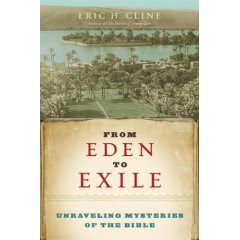
Eric Cline (From Eden to Exile: Unraveling Mysteries of the Bible) approaches the lost tribes theme from three angles, the biblical account, the Neo-Assyrian inscriptions and the archaeological remains.

"[W]e know that between the efforts of Tiglath-pileser III, Shalmaneser V, and Sargon II, more than 40,000 people were carried off from 733 to 720 BC... Archaeologists say that at least five times and perhaps nearly ten times that many people were living in the region during that time... Either way, 80 to 90 percent of the Ten Tribes of Israel would have been left to either stay on the land or flee to Judah... [E]xcavations... provide evidence for a tremendous explosion of growth not only in the city of Jerusalem but in all of Judah... just after the fall of Israel's northern kingdom"

Referring to the much used apocryphal passage in 2 Edras and comments by Josephus (both first century) Cline notes: "Clearly, by the first century AD (if not long before), the myth of the Ten Lost Tribes had already begun."

The mysterious land of Arzareth (2 Edras) is not a placename but "a corruption of two Hebrew words, Eretz Aheret, and simply means "another land.""

"This deportation and repopulation, known in politically correct terms as "population exchange" was a standard and very deliberate practice of the Neo-Assyrians."

"So what happened to the so-called Ten Lost Tribes of Israel? The answer is simple: They are not lost and never were. Yes, the northern kingdom of Israel itself officially ended by 720 BC, when it was incorporated into the Neo-Assyrian Empire. And yes, inhabitants of Samaria and Israel were indeed deported... However, only 20 percent... at most, were sent into exile."

"Even if 40,000 people were taken into exile and 80,000 fled south to Judah, at least 100,000 more - and perhaps as many as 230,000 people - would have remained in what was once Israel's northern kingdom... the fate that befell [Israel]... mirrors exactly the fate that would befall the people of Jerusalem and Judah a little more than a century later..."

"[E]ven if 40,000 people were carried off... this number pales in comparison with the number of people reportedly deported from Judah... Sennacherib says that he deported 200,150 people from its cities and villages..."

The detail can best be appreciated by reading the book, but hopefully there's enough here to whet the appetite of some readers for a discussion of this subject that has much greater credibility than anything churned out from those that still promote the racist ideologies of Herbert W Armstrong and his jingoistic predecessors.

Friday, 24 August 2007

Nuking the nutcases


Every so often a book comes along that brings a fresh breath of air to a stale subject. Eric Cline's From Eden to Exilepublished by National Geographic, is such a book.

Every lunatic and his mutt have an opinion about Noah's Ark (it's up there on a Turkish mountain still waiting to be found by John Warwick Montgomery), or the Ark of the Covenant (still humming with occult energies despite Indiana Jones). In the COG tradition there are numberless enthusiasts running around promoting mind-numbing versions of British-Israelism (the English are Ephraim), based on the tale of those hopelessly directionally-challenged Ten Tribes.

Time to shed some light, and Cline obliges. Sorting out the fact from the fiction, any Armstrong admirer past or present, or any other victim of fundagelicism, will find this an enlightening book. While Cline is a serious scholar, he knows how to write for the rest of us. He covers the location of Eden, the Flood, Sodom and Gomorrah, the Exodus, Joshua and Jericho, the Ark of the Covenant and, of particular interest to former WCG members, his final chapter covers those pesky tribes. These words from a review express it nicely:

"By Exile's end, Cline almost manages to state a definitive conclusion: The Ten Lost Tribes aren't lost at all, because most of them never left Palestine. But along the way, he's had his greatest successes deflating the wild claims of excitable documentary filmmakers like Simcha Jacobovici, evangelical nutcases like Ron Wyatt, and self-appointed pseudo-scholars like Tom Crotser." (source)

In fact, I haven't seen a single review by anyone with active brain cells that finds fault with From Eden to Exile. A great book to give as a gift to someone in the family who is attracted by the siren call of unrestrained biblicist speculation.

Recommended.

Thursday, 23 August 2007

Culture krieg - bring on Sinéad!


I'm a passionate aficionado of classical music. It's got me through some tough times. The affair began with an obscure recording of Handel's Messiah and I never looked back. I don't read music and I don't play, but Lord knows I can lose myself in a Tchaikovsky symphony.

The problem is that in the ex-WCG world such interests are viewed with suspicion given Herbert W. Armstrong's predilection for the arts. The guy was a major suck-up. His strategy: throw money at some European orchestra or pianist and grab the cultural kudos. The Ambassador Auditorium and the late, unlamented AICF were his ticket to credibility with the penguin-suited set, while the "grunts" in the pews tithed themselves into near poverty.

The only splinter sect that seems to share HWA's expensive tastes in generating faux-self esteem of this sort is the Edmond, OK Flurry cult, the curiously named Philadelphia Church of God. Like his idol, Papa Gerry enjoys playing the philanthropist (pronounced philan as in philanderer and pist as in, well, pissed.)

Which is my way of introducing a particularly cretinous bit of video PR from the Flurry camp (accessible from a menu on this page.) Obviously Gerry doesn't embarrass easily. If, like me, you appreciate the kind of music the six-pack prophet appropriates, why not send an email to the scheduled performers explaining why you're genuinely disappointed they're doing the Edmond gig. No need to give your life story, just a general indication that in your experience this is a high-demand sect with a dubious reputation.

While on matters musical, James Tabor is waxing lyrical on his blog about Sinéad O'Connor's recent album Theology. Yes, that's right, the Irish artist who has been excommunicated by Rome and has a reputation for colorful language. As I said, my poison is more Rachmaninov than whatever category Sinéad O'Connor comes under, but, after giving it a listen, hey, I can see his point. Now if Gerry was to bring O'Connor to Edmond, now that'd really be something special! Just imagine the follow-up sermons explaining that PCG will not be using her version of "Rivers of Babylon" and that it is not OK to refer to God as Jah in sermonettes!

Meantime I think I'll put some Mendelssohn on and pretend the cheap and cheeky little Aussie Merlot is actually Harveys Bristol Cream...